Mejor modelo - Precio electricidad#
# Importar librerías:
import pandas as pd
import numpy as np
import matplotlib.pyplot as plt
import matplotlib.dates as mdates
from sklearn.model_selection import train_test_split
from sklearn.preprocessing import MinMaxScaler
from sklearn.metrics import mean_squared_error, r2_score, mean_absolute_error
from scipy.stats import boxcox
from scipy.special import inv_boxcox
from keras.models import load_model
import statsmodels.api as sm
from scipy.stats import norm
from statsmodels.graphics.tsaplots import plot_acf, plot_pacf

# warning
import warnings
warnings.filterwarnings("ignore")
Función para evaluar el modelo#
def evaluar_modelo_ts(
    model,
    X_train, y_train,
    X_test, y_test,
    train_index,
    test_index,
    lags,
    scaler=None,
    transformacion=None,
    lambda_bc=None,
    nombre_modelo="Modelo",
    nombre_serie="Serie",
):
    """
    Evalúa un modelo de series de tiempo ya entrenado.
    Muestra métricas de desempeño y un gráfico de ajuste
    en train y test.

    Parámetros
    ----------
    model : keras Model
        Modelo ya cargado / entrenado.

    X_train, y_train, X_test, y_test : np.array
        Datos de entrenamiento y prueba (ya con lags aplicados).

    train_index, test_index : pd.DatetimeIndex o array-like
        Índices temporales COMPLETOS (antes de crear lags).

    lags : int
        Número de rezagos usados para crear X/y.

    scaler : sklearn scaler o None
        Para invertir el escalado.

    transformacion : str o None
        "log", "boxcox" o None.

    lambda_bc : float o None
        Lambda de Box-Cox.

    nombre_modelo : str
        Nombre para mostrar en títulos.

    nombre_serie : str
        Nombre de la serie para el eje Y.

    Retorna
    -------
    metricas : dict
        Diccionario con todas las métricas calculadas.
    """

    # -------------------------------------------------
    # Funciones de inversión
    # -------------------------------------------------
    def invertir_a_escala_original(valores):
        resultado = valores.copy().flatten()
        if scaler is not None:
            resultado = scaler.inverse_transform(
                resultado.reshape(-1, 1)
            ).flatten()
        if transformacion == "log":
            resultado = np.exp(resultado)
        elif transformacion == "boxcox":
            resultado = inv_boxcox(resultado, lambda_bc)
        return resultado

    # -------------------------------------------------
    # Predicciones
    # -------------------------------------------------
    y_train_pred = model.predict(X_train, verbose=0).flatten()
    y_test_pred = model.predict(X_test, verbose=0).flatten()

    idx_train = train_index[lags:]
    idx_test = test_index[lags:]

    hay_inversion = (scaler is not None) or (transformacion is not None)

    # -------------------------------------------------
    # Métricas en espacio escalado
    # -------------------------------------------------
    rmse_train = np.sqrt(mean_squared_error(y_train, y_train_pred))
    rmse_test = np.sqrt(mean_squared_error(y_test, y_test_pred))
    mae_train = mean_absolute_error(y_train, y_train_pred)
    mae_test = mean_absolute_error(y_test, y_test_pred)
    r2_train = r2_score(y_train, y_train_pred)
    r2_test = r2_score(y_test, y_test_pred)

    metricas = {
        "rmse_train_scaled": rmse_train,
        "rmse_test_scaled": rmse_test,
        "mae_train_scaled": mae_train,
        "mae_test_scaled": mae_test,
        "r2_train_scaled": r2_train,
        "r2_test_scaled": r2_test,
    }

    # -------------------------------------------------
    # Métricas en escala original
    # -------------------------------------------------
    if hay_inversion:
        y_tr_inv = invertir_a_escala_original(y_train)
        y_te_inv = invertir_a_escala_original(y_test)
        y_tr_pred_inv = invertir_a_escala_original(y_train_pred)
        y_te_pred_inv = invertir_a_escala_original(y_test_pred)

        rmse_train_o = np.sqrt(mean_squared_error(y_tr_inv, y_tr_pred_inv))
        rmse_test_o = np.sqrt(mean_squared_error(y_te_inv, y_te_pred_inv))
        mae_train_o = mean_absolute_error(y_tr_inv, y_tr_pred_inv)
        mae_test_o = mean_absolute_error(y_te_inv, y_te_pred_inv)
        r2_train_o = r2_score(y_tr_inv, y_tr_pred_inv)
        r2_test_o = r2_score(y_te_inv, y_te_pred_inv)

        metricas.update({
            "rmse_train_original": rmse_train_o,
            "rmse_test_original": rmse_test_o,
            "mae_train_original": mae_train_o,
            "mae_test_original": mae_test_o,
            "r2_train_original": r2_train_o,
            "r2_test_original": r2_test_o,
        })
    else:
        y_tr_inv = y_train
        y_te_inv = y_test
        y_tr_pred_inv = y_train_pred
        y_te_pred_inv = y_test_pred
        rmse_train_o = rmse_train
        rmse_test_o = rmse_test
        mae_train_o = mae_train
        mae_test_o = mae_test
        r2_train_o = r2_train
        r2_test_o = r2_test

    # -------------------------------------------------
    # Imprimir métricas
    # -------------------------------------------------
    print(f"\n{'═'*62}")
    print(f"  {nombre_modelo}")
    print(f"{'═'*62}")

    if hay_inversion:
        print(f"\n  ▸ Espacio escalado/transformado:")
        print(f"    {'Métrica':<12} {'Train':>12} {'Test':>12}")
        print(f"    {'─'*36}")
        print(f"    {'RMSE':<12} {rmse_train:>12.6f} {rmse_test:>12.6f}")
        print(f"    {'MAE':<12} {mae_train:>12.6f} {mae_test:>12.6f}")
        print(f"    {'R²':<12} {r2_train:>12.6f} {r2_test:>12.6f}")

        print(f"\n  ▸ Escala original:")
        print(f"    {'Métrica':<12} {'Train':>12} {'Test':>12}")
        print(f"    {'─'*36}")
        print(f"    {'RMSE':<12} {rmse_train_o:>12.4f} {rmse_test_o:>12.4f}")
        print(f"    {'MAE':<12} {mae_train_o:>12.4f} {mae_test_o:>12.4f}")
        print(f"    {'R²':<12} {r2_train_o:>12.6f} {r2_test_o:>12.6f}")
    else:
        print(f"\n  {'Métrica':<12} {'Train':>12} {'Test':>12}")
        print(f"  {'─'*36}")
        print(f"  {'RMSE':<12} {rmse_train_o:>12.6f} {rmse_test_o:>12.6f}")
        print(f"  {'MAE':<12} {mae_train_o:>12.6f} {mae_test_o:>12.6f}")
        print(f"  {'R²':<12} {r2_train_o:>12.6f} {r2_test_o:>12.6f}")

    print(f"{'═'*62}\n")

    # -------------------------------------------------
    # Gráfico de ajuste (estilo ggplot)
    # -------------------------------------------------
    with plt.style.context("ggplot"):
        plt.figure(figsize=(12, 6))
        plt.plot(idx_train, y_tr_inv, label="Real Train", color="black")
        plt.plot(
            idx_train, y_tr_pred_inv,
            label="Ajuste Train", color="tab:blue",
        )
        plt.plot(idx_test, y_te_inv, label="Real Test", color="black")
        plt.plot(
            idx_test, y_te_pred_inv,
            label="Pronóstico Test", color="tab:green",
        )
        plt.title(f"Ajuste y pronóstico - {nombre_modelo}")
        plt.xlabel("Tiempo")
        plt.ylabel(nombre_serie)
        plt.legend()
        plt.tight_layout()
        plt.show()

    return metricas
Función para analizar los residuales#
def analisis_residuales(
    residuals,
    nombre: str = "Serie de tiempo",
    lags: int = 24,
    color_resid: str = "navy",
    color_qq: str = "navy",
    color_acf_pacf: str = "navy"
):
    """
    Análisis gráfico de residuales:
    - Residuales en el tiempo (toda la fila superior)
    - Histograma + curva normal (izq), QQ-plot (der)
    - ACF (izq), PACF (der) con bandas y barras color navy
    """
    residuals = residuals[1:].dropna()

    # Ensure mu and sigma are scalar values
    if isinstance(residuals, pd.DataFrame) and 'Precio' in residuals.columns:
        mu = residuals['Precio'].mean()
        sigma = residuals['Precio'].std(ddof=1)
    elif isinstance(residuals, pd.Series):
        mu = residuals.mean()
        sigma = residuals.std(ddof=1)
    else:
        mu = residuals.mean().iloc[0] if hasattr(residuals.mean(), 'iloc') else residuals.mean()
        sigma = residuals.std(ddof=1).iloc[0] if hasattr(residuals.std(ddof=1), 'iloc') else residuals.std(ddof=1)

    x = np.linspace(residuals.min().min() if isinstance(residuals, pd.DataFrame) else residuals.min(),
                    residuals.max().max() if isinstance(residuals, pd.DataFrame) else residuals.max(),
                    400)
    pdf = norm.pdf(x, loc=mu, scale=sigma)

    with plt.style.context("ggplot"):
        fig = plt.figure(constrained_layout=True, figsize=(14, 11))
        gs = fig.add_gridspec(3, 2, height_ratios=[1, 1, 1])

        # 1. Residuales en el tiempo
        ax_time = fig.add_subplot(gs[0, :])
        ax_time.scatter(residuals.index, residuals, color=color_resid, alpha=0.7, s=20)
        ax_time.axhline(0, ls="--", color="black")
        ax_time.set_title(f"Residuales en el tiempo: {nombre}", color='black')
        ax_time.set_xlabel("Tiempo", color='black')
        ax_time.set_ylabel("Residual", color='black')
        ax_time.tick_params(axis='both', labelsize=11, colors='black')

        # 2. Histograma + curva Normal
        ax_hist = fig.add_subplot(gs[1, 0])
        ax_hist.hist(residuals, bins="auto", density=True, alpha=0.6, edgecolor="k", color="royalblue")
        ax_hist.plot(x, pdf, lw=2, label=f"N({mu:.3f}, {sigma:.3f}²)", color="darkred")
        ax_hist.set_title("Histograma residuales y ajuste Normal", color='black')
        ax_hist.set_xlabel("Residual", color='black')
        ax_hist.set_ylabel("Densidad", color='black')
        ax_hist.legend(fontsize=9)
        ax_hist.grid(alpha=0.18)
        ax_hist.tick_params(axis='both', labelsize=10, colors='black')

        # 3. QQ-plot
        ax_qq = fig.add_subplot(gs[1, 1])
        qq = sm.qqplot(residuals.iloc[:, 0] if isinstance(residuals, pd.DataFrame) else residuals, line='45', fit=True, ax=ax_qq, markerfacecolor=color_qq, markeredgecolor=color_qq, marker='o')
        lines = ax_qq.get_lines()
        if len(lines) >= 1:
            lines[0].set_color(color_qq)
            lines[0].set_marker('o')
            lines[0].set_linestyle('None')
        if len(lines) >= 2:
            lines[1].set_color("black")
            lines[1].set_linestyle("--")
        ax_qq.set_title("Q-Q Plot de los residuales", color='black')
        ax_qq.set_xlabel("Cuantiles teóricos (Normal)", color='black')
        ax_qq.set_ylabel("Cuantiles de los residuales", color='black')
        ax_qq.tick_params(axis='both', labelsize=10, colors='black')
        for l in ax_qq.get_xticklabels() + ax_qq.get_yticklabels():
            l.set_color('black')

        # 4. ACF
        ax_acf = fig.add_subplot(gs[2, 0])
        sm.graphics.tsa.plot_acf(residuals.iloc[:, 0] if isinstance(residuals, pd.DataFrame) else residuals, lags=lags, ax=ax_acf, zero=False, color=color_acf_pacf)
        ax_acf.set_title("ACF de los residuales", color='black')
        ax_acf.set_xlabel("Rezagos", color='black')
        ax_acf.set_ylabel("Autocorrelación", color='black')
        ax_acf.tick_params(axis='both', labelsize=10, colors='black')

        # 5. PACF
        ax_pacf = fig.add_subplot(gs[2, 1])
        sm.graphics.tsa.plot_pacf(residuals.iloc[:, 0] if isinstance(residuals, pd.DataFrame) else residuals, lags=lags, ax=ax_pacf, zero=False, color=color_acf_pacf)
        ax_pacf.set_title("PACF de los residuales", color='black')
        ax_pacf.set_xlabel("Rezagos", color='black')
        ax_pacf.set_ylabel("Autocorrelación parcial", color='black')
        ax_pacf.tick_params(axis='both', labelsize=10, colors='black')

        plt.show()

    return
Datos:#
# Cargar datos:
data = pd.read_excel("Precio_diario.xlsx")
data.index = pd.to_datetime(data['Fecha'])
data.drop('Fecha', axis=1, inplace=True)
print(data.head())
plt.figure(figsize=(15,5))
plt.plot(data['Precio'], color="black", label="Precio electricidad diario")
plt.legend()
plt.show()
               Precio
Fecha
2002-05-01  40.802839
2002-05-02  41.677618
2002-05-03  37.826814
2002-05-04  37.904091
2002-05-05  36.266849
# Función para crear los lags para RNA
def prepare_data(precio, n_lags):
    X = []
    y = []
    for i in range(n_lags, len(precio)):

        lag_features = precio[i - n_lags : i, 0]  # Extraemos el vector de lags
        X.append(lag_features)
        # El target es el valor en la posición actual
        y.append(precio[i, 0])

    # Convertimos las listas a numpy.ndarray
    X = np.array(X)
    y = np.array(y)

    return X, y

# Función para crear los lags para redes RNN, GRU y LSTM
def prepare_data_rnn(precio, n_lags):
    X = []
    y = []
    for i in range(n_lags, len(precio)):

        lag_features = precio[i - n_lags : i, 0]  # Extraemos el vector de lags
        X.append(lag_features)
        # El target es el valor en la posición actual
        y.append(precio[i, 0])

    # Convertimos las listas a numpy.ndarray
    X = np.array(X)
    y = np.array(y)
    X = X.reshape(X.shape[0], n_lags, 1)

    return X, y
Transformaciones serie de tiempo:#
# Transformación logarítmica a la serie original
serie_log = np.log(data['Precio'])
data_log = pd.DataFrame(serie_log, columns=['Precio'])

# Transformación Box-Cox a la serie original
serie_bc, lambda_bc = boxcox(data['Precio'])
data_bc = pd.DataFrame(serie_bc, columns=['Precio'], index=data.index)
# Conjunto de Train y Test:
train, test = train_test_split(data_bc, test_size=0.30, shuffle=False)
# Escalado de variables:
scaler = MinMaxScaler()
scaler.fit(train)
train_scaled = scaler.transform(train)
test_scaled = scaler.transform(test)
Cargar mejor modelo: Redes Neuronales#
# Cargar modelo keras
model = load_model('modelo_2_GRU_lags_60.keras')
# Creación de lags:
lags = 60
X_train, y_train = prepare_data_rnn(train_scaled, lags)
X_test, y_test = prepare_data_rnn(test_scaled, lags)
Evaluación del modelo#
metricas = evaluar_modelo_ts(
    model=model,
    X_train=X_train, y_train=y_train,
    X_test=X_test, y_test=y_test,
    train_index=train.index,
    test_index=test.index,
    lags=lags,
    scaler=scaler,
    transformacion="boxcox",       # o "log" o None
    lambda_bc=lambda_bc,
    nombre_modelo="GRU — Mejor Modelo",
    nombre_serie="Precio",
)
══════════════════════════════════════════════════════════════
  GRU — Mejor Modelo
══════════════════════════════════════════════════════════════

  ▸ Espacio escalado/transformado:
    Métrica             Train         Test
    ────────────────────────────────────
    RMSE             0.038879     0.034798
    MAE              0.026712     0.024226
    R²               0.946227     0.942441

  ▸ Escala original:
    Métrica             Train         Test
    ────────────────────────────────────
    RMSE              29.6251      82.2282
    MAE               12.5171      39.6053
    R²               0.956445     0.920795
══════════════════════════════════════════════════════════════
Análisis de residuales#
# Ajuste en train
y_train_pred = model.predict(X_train, verbose=0).flatten()

# Devolver scaler
y_train_pred_inv = scaler.inverse_transform(y_train_pred.reshape(-1, 1)).flatten()
y_train_pred_inv = pd.Series(y_train_pred_inv, index=train.index[lags:])
residuales = train['Precio'][lags:] - y_train_pred_inv
analisis_residuales(
    residuales,      # Agregar los residuales
    nombre="Precio de electricidad",
)
Cargar mejor modelo: CNN#
# Cargar modelo keras
model = load_model('modelo_1_CNN_Dense_lags_40.keras')
# Creación de lags:
lags = 40
X_train, y_train = prepare_data_rnn(train_scaled, lags)
X_test, y_test = prepare_data_rnn(test_scaled, lags)
Evaluación del modelo#
metricas = evaluar_modelo_ts(
    model=model,
    X_train=X_train, y_train=y_train,
    X_test=X_test, y_test=y_test,
    train_index=train.index,
    test_index=test.index,
    lags=lags,
    scaler=scaler,
    transformacion="boxcox",       # o "log" o None
    lambda_bc=lambda_bc,
    nombre_modelo="CNN + Dense — Mejor Modelo",
    nombre_serie="Precio",
)
══════════════════════════════════════════════════════════════
  CNN + Dense — Mejor Modelo
══════════════════════════════════════════════════════════════

  ▸ Espacio escalado/transformado:
    Métrica             Train         Test
    ────────────────────────────────────
    RMSE             0.044422     0.050793
    MAE              0.033612     0.041175
    R²               0.930954     0.876672

  ▸ Escala original:
    Métrica             Train         Test
    ────────────────────────────────────
    RMSE              65.0409     175.0175
    MAE               21.4667      87.4161
    R²               0.789722     0.638411
══════════════════════════════════════════════════════════════
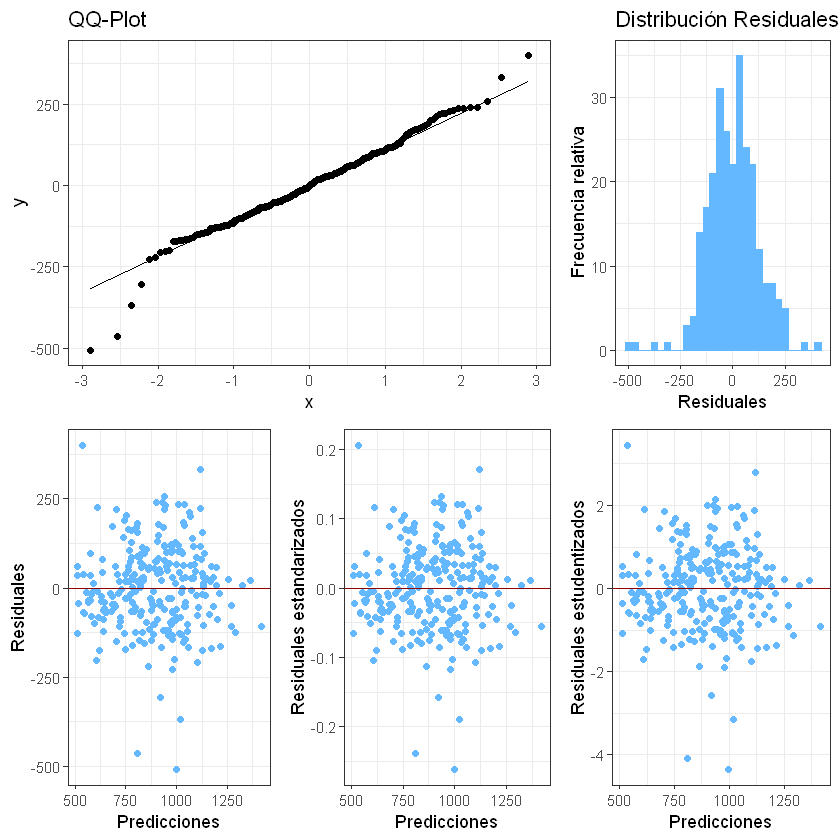
Análisis de residuales#
# Ajuste en train
y_train_pred = model.predict(X_train, verbose=0).flatten()

# Devolver scaler
y_train_pred_inv = scaler.inverse_transform(y_train_pred.reshape(-1, 1)).flatten()
y_train_pred_inv = pd.Series(y_train_pred_inv, index=train.index[lags:])
residuales = train['Precio'][lags:] - y_train_pred_inv
analisis_residuales(
    residuales,      # Agregar los residuales
    nombre="Precio de electricidad",
)